

Unlocking Nanoscale Chemical Insights in Semiconductor Thin Films
Pusan National University achieves breakthrough in local chemical composition and interface analysis with Park FX200 IR.
- Customer: Pusan National University (Nano Semiconductor Process & Equipment Contract Dept.
- Research Focus: Solar cell absorber layers, Semiconductor thin film surface properties
- Solution: Park FX200 IR (Nano-IR: Nanoscale Infrared Spectroscopy)
- Key Value: Local chemical composition mapping, Multilayer cross-section interface characterization
The Challenge
Research at Pusan National University’s semiconductor thin film group routinely relied on standard AFM to characterize surface properties. But as the work advanced, a fundamental gap emerged: the team needed to see not just topography, but the chemical identity of specific layers within multilayer film structures.
Organic additives used for film optimization are present in trace quantities. Knowing where those compounds reside within the layer stack — not merely that they exist — was critical to advancing the research.
“As films become thinner, interfacial chemical composition grows increasingly decisive —
yet what the research demanded was not merely detecting trace compounds,
but chemically mapping and identifying them with nanoscale spatial precision.”
— Dr. In Hwa Cho, Research Professor, Pusan National University
The Solution
The team selected the Park FX200 IR based on a clear hypothesis: if molecular vibrations could be observed even in very thin layers, the spatial distribution of chemical compounds would become visible for the first time.
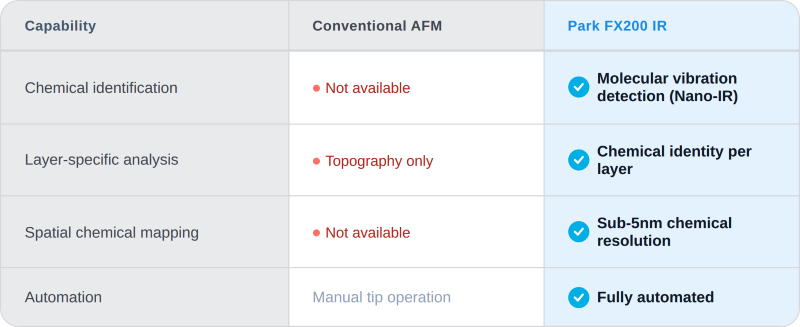
- Decisive Analytical Value: IR Capability: IR measurement enables direct observation of molecular vibrations, providing chemical identity alongside spatial information — something conventional topography-based AFM cannot achieve.
- Chemical Identity with Spatial Information: The system clearly distinguishes individual layers in multilayer cross-sectional structures by detecting molecular vibrations in each layer — including specific functional layers such as the HTL.
- Publication-Ready Data: Localized molecular vibration data is inherently difficult to obtain — when acquired, images carry high publication potential.
Why FX200 IR: Capabilities Beyond Conventional AFM
The Results
The FX200 IR delivered what the team had sought: the ability to clearly distinguish and characterize individual layers in multilayer samples through molecular vibration detection.
Topography and functional group data were acquired from multiple samples. A paper has been published based on the cross-sectional FX200 IR findings. Across the team, confidence in data interpretation improved significantly.
“The system differentiates layers in cross-sectional structure. Being able to distinguish molecular vibrations in specific layers — it was remarkable and the data was extremely valuable.”
— Dr. In Hwa Cho
Key Outcomes
- Topography + functional group data acquired from multiple samples
- Clear layer distinction in cross-sectional multilayer samples
- Paper published based on FX200 IR findings
- Improved data interpretation following FX200 IR adoption
About Park FX200 IR
The Park FX200 IR combines atomic force microscopy with Nanoscale Infrared Spectroscopy (Nano-IR) to deliver nanoscale chemical identification alongside topographical imaging. Capabilities include: local chemical composition mapping, multilayer cross-section interface characterization, functional group identification in thin films, and fast stable imaging up to 100 μm × 100 μm with consistently low noise.
Learn more: www.parksystems.com/fx200-ir