


Zirconia (ZrO₂)


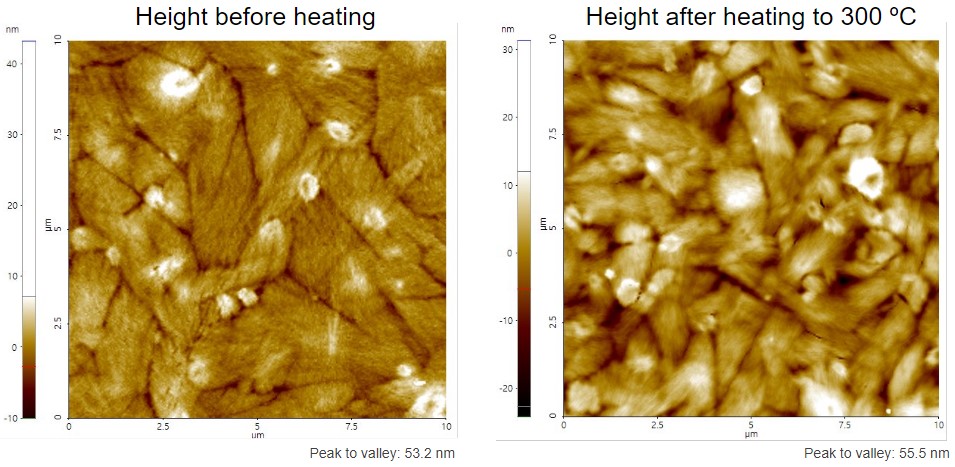
The surface of zircornia (ZrO₂) undergoes temperature-dependent changes that impact its properties and structure. At higher temperatures, ZrO₂ can experience phase transitions, transforming from a monoclinic to a tetragonal or cubic crystal structure. These temperature-induced changes influence the material's mechanical, thermal, and electrical characteristics.
Scanning Conditions
- System: NX7
- Scan Mode: True Non-Contact™ Mode
- Scan Rate: 1 Hz
- Scan Size: 10 µm×10 µm
- Pixel Size: 256×256
- Cantilever: AC160TS (k=26 N/m, f=300 kHz)
Related Contents

System Webinars
What can we learn from scanning electrochemical probe microscopy (SEPM) studies on interfaces and interphases of battery electrodes

System Webinars
From Single Hologram to 3D Volumetric & 4D Time-Resolved Insight in Various Fields of Science

System Webinars
Beyond Conventional Ellipsometry: High-Resolution Mapping of Oxide Thin Film
×