


How antisolvent miscibility affects perovskite film wrinkling and photovoltaic properties


- Journal: nature communications
- Published Year: 2021
- Authors: Seul-Gi Kim, Jeong-Hyeon Kim, Philipp Ramming, Yu Zhong, Konstantin Schötz, Seok Joon Kwon, Sven Huettner, Fabian Panzer & Nam-Gyu Park
- Application: Perovskite Photovoltaics, Thin-Film Manufacturing, Solar devices, optoelectronics
Summary
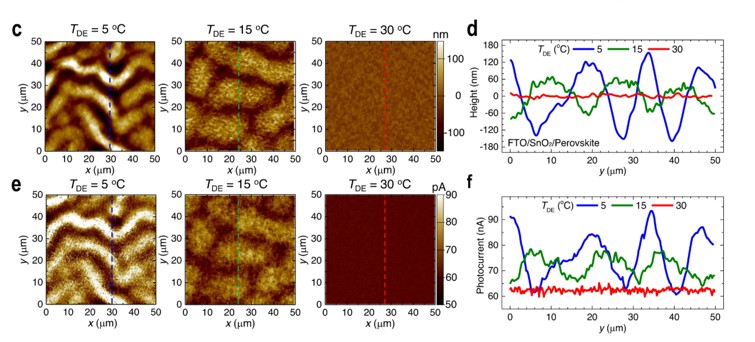
This study explores how antisolvent miscibility controls microscopic wrinkling in mixed-cation perovskite films to enhance solar-cell performance. By varying diethyl ether temperature during DMSO-based spin coating, the authors induced tunable wrinkles (amplitude ~120 nm; wavelength ~13 µm), mapped by AFM topography. Photoconductive AFM (pc‑AFM) probed local photocurrent, showing enhanced carrier transport at wrinkle peaks. These insights tied film morphology to carrier dynamics, driving efficiency up to 23.0%, and improving stability in perovskite photovoltaics.

Related Contents

System Webinars
What can we learn from scanning electrochemical probe microscopy (SEPM) studies on interfaces and interphases of battery electrodes

System Webinars
From Single Hologram to 3D Volumetric & 4D Time-Resolved Insight in Various Fields of Science

System Webinars