


Programming ultrasensitive threshold response through chemomechanical instability


- Journal: nature communications
- Published Year: 2021
- Authors: Young-Joo Kim, Junho Park, Jae Young Lee & Do-Nyun Kim
- Application: nanotechnology, synthetic biology, biosensing, drug delivery
Summary
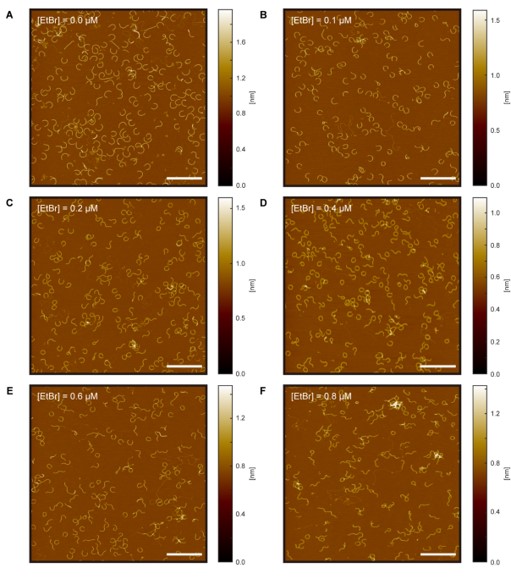
This study demonstrates programmable ultrasensitive threshold responses in DNA origami rings via chemomechanical instability. DNA origami rings were exposed to DNA intercalators (EtBr, DOX, YOYO-1), inducing torsional stress that triggers Michell’s instability. Atomic force microscopy (AFM) visualized ring conformations at varying intercalator concentrations, confirming sharp structural transitions at critical thresholds. This AFM-derived structural data was essential to correlate molecular-level reconfiguration with predicted mechanical models, validating programmable responsiveness in synthetic biomolecular systems.

Related Contents

System Webinars
What can we learn from scanning electrochemical probe microscopy (SEPM) studies on interfaces and interphases of battery electrodes

System Webinars
From Single Hologram to 3D Volumetric & 4D Time-Resolved Insight in Various Fields of Science

System Webinars